Utility Modernization Investments Risk Adding Complexity Without a Technical Reference Architecture, Says Info-Tech Research Group
PR Newswire
ARLINGTON, Va., June 3, 2026
As utilities respond to electrification, smart grid modernization, regulatory pressure, and rising customer expectations, many are still constrained by legacy systems, data silos, and fragmented IT/OT environments. Info-Tech Research Group's newly published blueprint, Build a Technical Reference Architecture for Utilities, outlines a practical framework to help utility leaders connect technical capabilities to business priorities, reduce architectural complexity, and embed governance into technology investment decisions.
ARLINGTON, Va., June 3, 2026 /PRNewswire/ - Utilities are under pressure to modernize aging technology environments while supporting electrification, smart grid initiatives, and rising expectations for digital service. However, new insights from Info-Tech Research Group indicate that modernization efforts can create additional complexity when technical decisions are not clearly connected to business capabilities, governance, and long-term investment priorities.
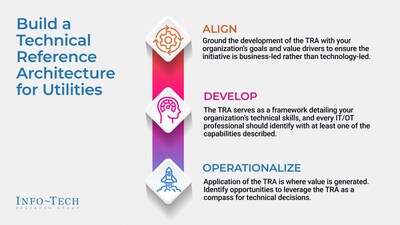
To help utility organizations address these challenges, the global research and advisory firm has recently published its blueprint, Build a Technical Reference Architecture for Utilities. The resource provides a structured framework for developing and operationalizing a technical reference architecture (TRA), enabling leaders to align technology capabilities with business priorities, improve interoperability, reduce duplication, and make more informed investment decisions.
According to Info-Tech's resource findings, one of the most common challenges utility organizations face is linking architectural decisions to business outcomes such as grid reliability, regulatory compliance, customer experience, operational efficiency, and resilience. When technical architectures are developed independently from business priorities, technology initiatives can become disconnected from organizational value, making it more difficult to justify investments, measure results, and sustain modernization efforts.
"Utilities do not need more technology in isolation. They need a clearer way to connect technical decisions to reliability, compliance, customer experience, and operational value," says Bevin Chau, research director at Info-Tech Research Group. "A technical reference architecture gives leaders the standards, interfaces, and governance needed to modernize with discipline rather than simply adding more complexity."
Info-Tech's Three-Phase Framework for Building a Technical Reference Architecture for Utilities
A key finding from Info-Tech's blueprint is that organizations derive the greatest value from architecture when it is operationalized rather than treated as a standalone deliverable. The firm's resource emphasizes that a TRA should serve as a strategic compass, design playbook, and governance framework that guides technology decisions, investment planning, risk management, and modernization efforts across the organization.
To help utility leaders put these principles into practice, the Build a Technical Reference Architecture for Utilities blueprint outlines the following three-phase approach:
- Phase 1: Align Technology to Organizational Goals: Organizations begin by leveraging a business reference architecture (BRA) to identify value streams, business capabilities, and organizational priorities that technology must support. Architectural principles are then established to guide future technology decisions and ensure the TRA is business-led rather than technology-led.
- Phase 2: Develop Current- and Target-State Technical Architectures: IT leaders in utilities assess existing technical capabilities across applications, data, integration, security, infrastructure, analytics, service management, and operational technology environments. This process helps identify capability gaps, redundancies, and technical debt that may limit modernization efforts.
- Phase 3: Operationalize the Architecture Through Governance and Use Cases: Rather than remaining a static document, the architecture is embedded into governance processes, technology investment planning, standards development, risk assessments, and innovation initiatives to support ongoing decision-making.
"Utilities are operating in an environment of rising demand, increasing complexity, and accelerating technological change," explains Chau. "Organizations that align technical capabilities with business capabilities and establish clear governance are better positioned to reduce complexity, improve interoperability, and make informed decisions about future technology investments."
Info-Tech's blueprint also provides baseline technical reference architectures for electricity, natural gas, water, and wastewater utilities, along with guidance for mapping current and target-state capabilities, identifying ownership across IT and OT, and applying heat maps to support investment planning, risk assessment, AI use cases, and IT/OT convergence opportunities.
By applying Info-Tech's framework, utility leaders can move the TRA from a static architecture artifact to a practical decision-making tool that supports investment planning, risk identification, resource alignment, and modernization roadmaps. For utility organizations seeking to strengthen technology governance, modernize legacy environments, and improve alignment between business and technology priorities, the blueprint provides practical guidance for building and sustaining a technical reference architecture that supports long-term organizational objectives.
For exclusive and timely commentary from Info-Tech's experts, including Bevin Chau, and access to the complete Build a Technical Reference Architecture for Utilities blueprint, please contact pr@infotech.com.
About Info-Tech Research Group
Info-Tech Research Group is the "get things done" partner for over 30,000 IT, HR, and marketing leaders worldwide. The fastest growing research and advisory firm, Info-Tech, enables leaders to make well-informed decisions and transform their organizations through AI, strategic foresight, step-by-step methodologies, practical tools, industry-leading advisory, and training programs. For nearly 30 years, tens of thousands of private and public organizations have trusted Info-Tech to lead their most important initiatives through periods of change and deliver outcomes that truly matter.
To learn more about Info-Tech's HR research and advisory services, visit McLean & Company, and for data-driven software buying insights and vendor evaluations, visit the firm's SoftwareReviews platform.
Media professionals can register for unrestricted access to research across IT, HR, and software, as well as hundreds of industry analysts through the firm's Media Insiders program. To gain access, contact pr@infotech.com.
For information about Info-Tech Research Group or to access the latest research, visit infotech.com and connect via LinkedIn and X.

 View original content to download multimedia:https://www.prnewswire.com/news-releases/utility-modernization-investments-risk-adding-complexity-without-a-technical-reference-architecture-says-info-tech-research-group-302790705.html
SOURCE Info-Tech Research Group